
Practical guides · maintenance
Electrical Maintenance Planning for Small Business Owners
A practical division between staff observations and qualified electrical work, with guidance on warning signs, equipment changes, maintenance intervals and useful records.
What you’ll learn
- Staff should observe and report changes, not open equipment or diagnose live faults.
- Recurring trips need assessment; smoke, flame, active arcing, burning odors and suspected shock require emergency escalation.
- Keep electrical access clear and review proposed equipment changes before installation.
- Use equipment-specific maintenance intervals and retain findings, corrective actions and unresolved recommendations.
Electrical maintenance planning starts with a clear division of responsibility: what employees should notice, what they should report and what belongs to qualified professionals. For a small business, the goal is a usable plan—not a binder that nobody opens. This guide explains how to handle recurring concerns, preserve useful records and discuss maintenance needs without assuming every workplace needs the same schedule.
1. Give staff a clear observation role
Give staff a simple assignment: recognize visible changes, stop using suspect equipment and report concerns. Do not ask them to diagnose an electrical fault. Training should match their duties and exposure; an experienced store manager or maintenance generalist is not automatically qualified for electrical work.
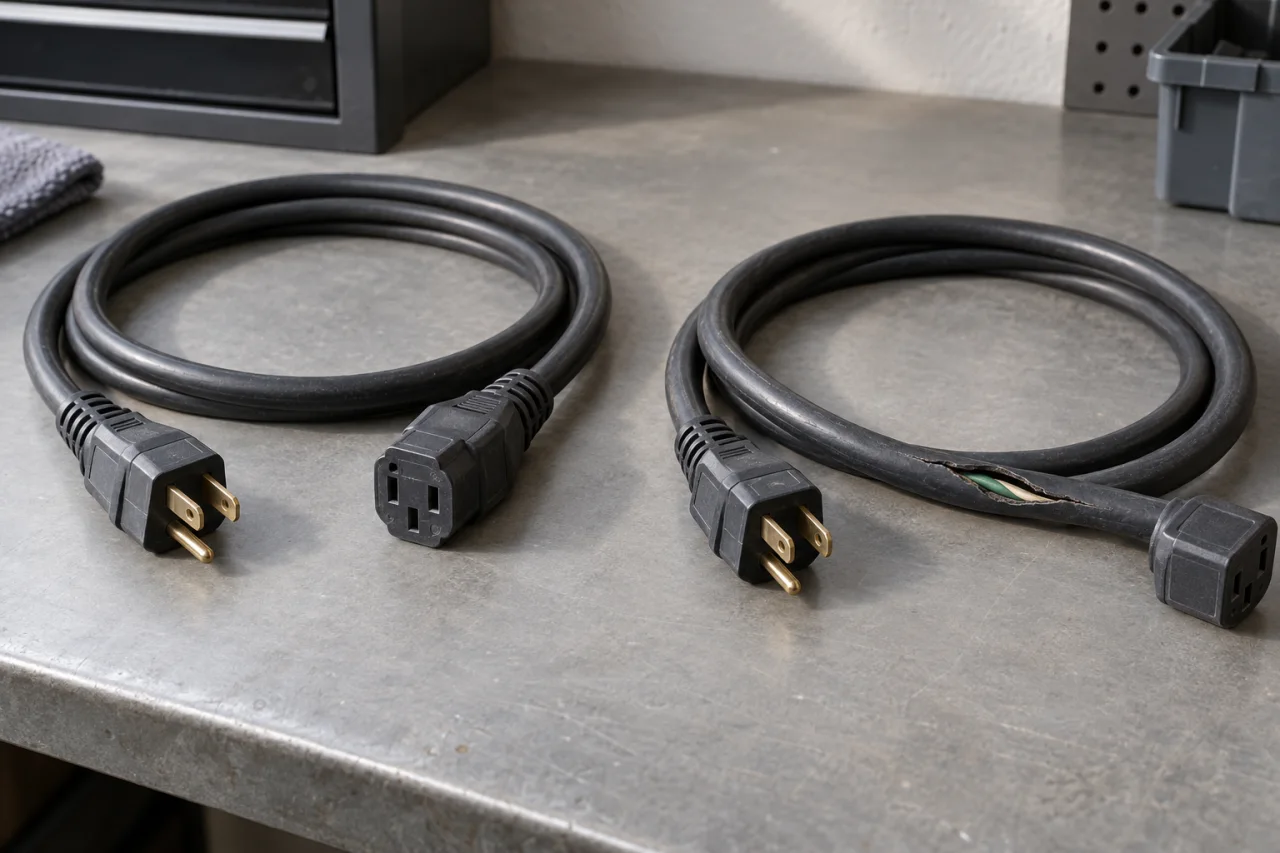
For portable cord-connected equipment, visual observations can identify crushed insulation, damaged plugs or missing pins. Required pre-use checks have an exception for equipment that remains connected and is not exposed to damage until it is relocated. Equipment with damage that could cause injury must be removed from service until necessary repairs and testing make it safe.
Put reporting responsibility in writing. Identify a primary contact, a backup and a way to prevent another shift from unknowingly reusing a reported item. A staff report starts a decision; it does not certify equipment as safe.
2. Separate recurring faults from emergencies
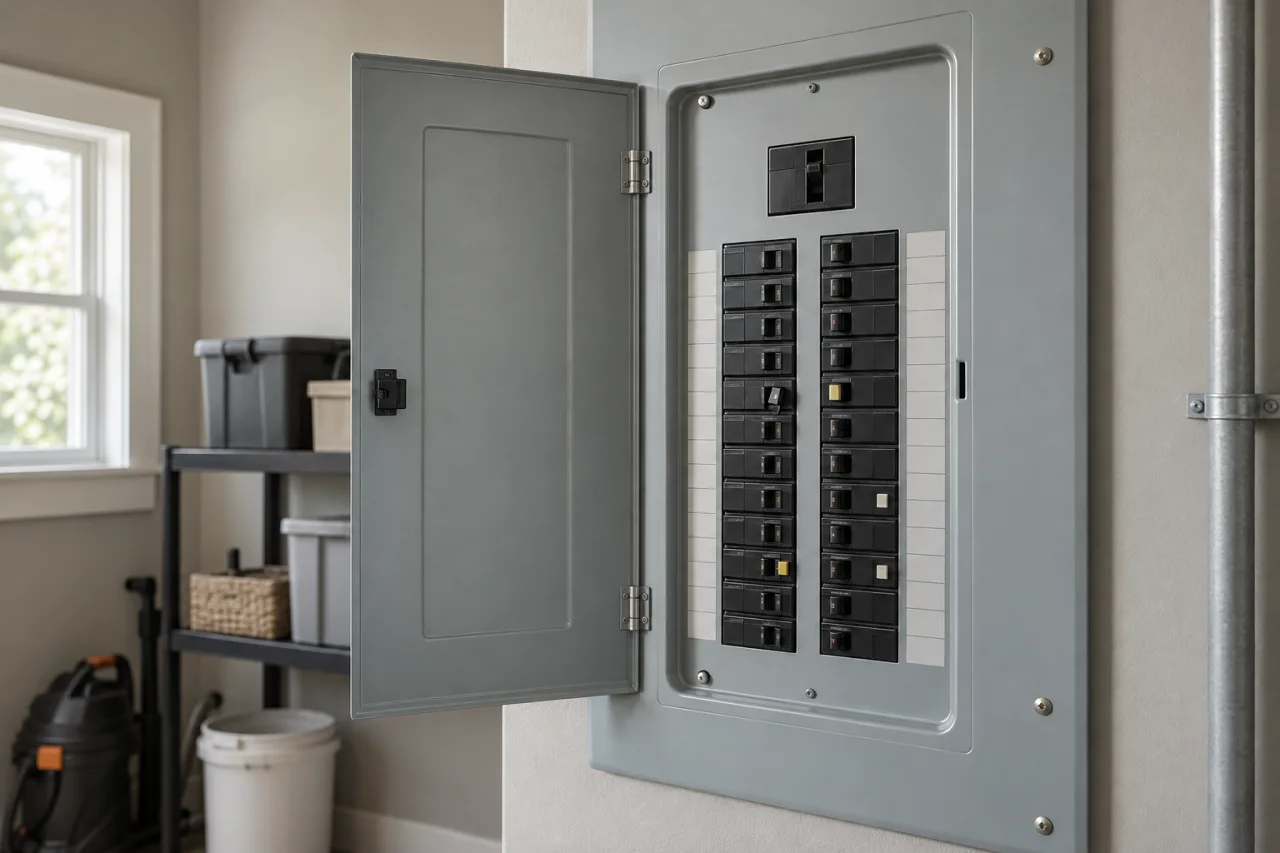
A recurring breaker trip deserves assessment, not another reset to finish the day. Repetitive manual reclosing is prohibited in workplace electrical safety requirements, and a circuit must not be manually reenergized until it has been determined safe to do so.
Record what was operating, when power stopped and whether the pattern followed an equipment change. Do not deliberately recreate the trip. Our guide to why a circuit breaker keeps tripping provides additional context without turning the symptom into a diagnosis.
Smoke, flame, active arcing or an electrical burning odor require a different response: move away, evacuate and call 911 from a safe location. Do not search inside equipment or approach a suspect panel to shut it down. For suspected electric shock, call 911 or emergency medical help; do not touch someone who may still be contacting the source. Electrical injury can include internal burns.
Emergency Electrical Services can address electrical repair needs, but an electrician enquiry must never replace fire response or medical care.
3. Protect access as the business changes
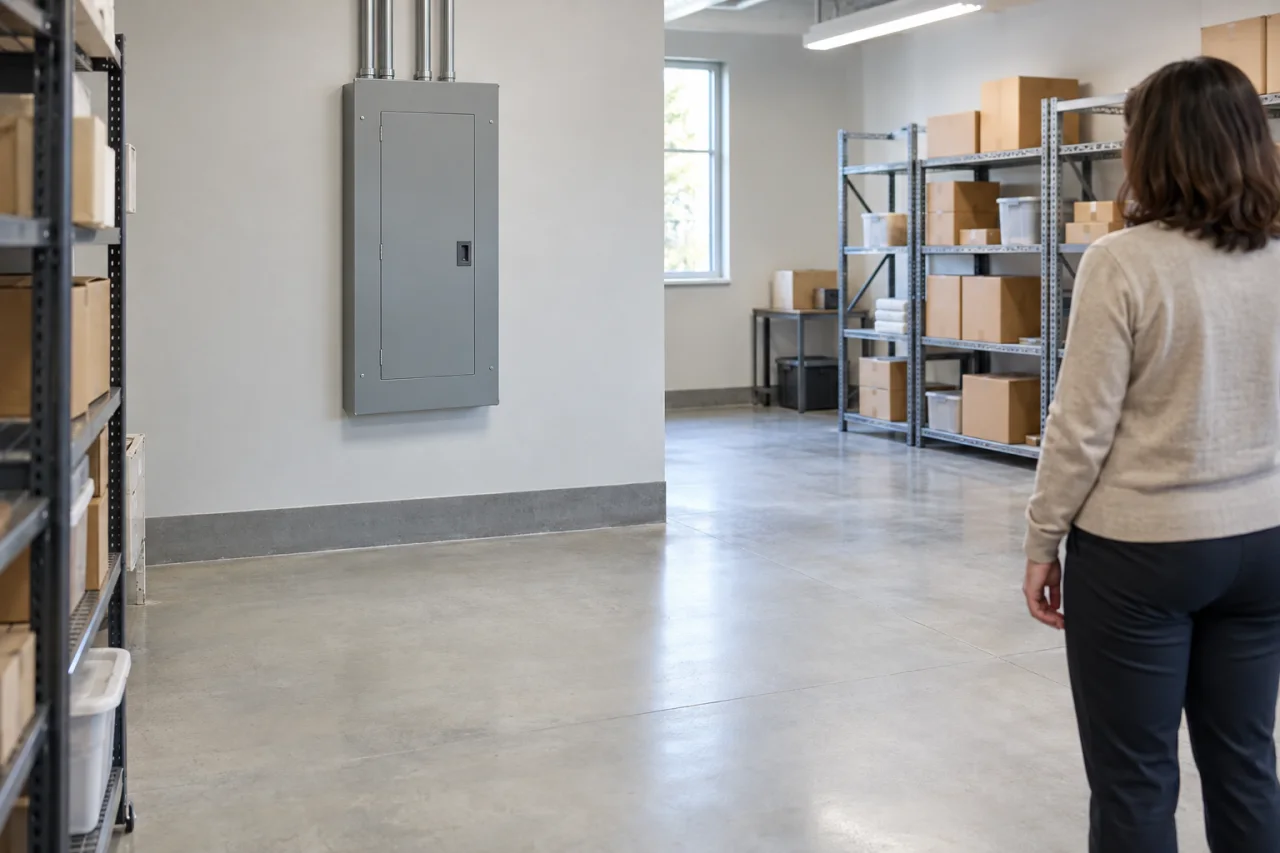
A stockroom can gradually become an electrical access problem even when nothing has failed. Required working space is not storage space. Clearance requirements depend on equipment and installation conditions, so avoid treating a painted floor outline or a generic distance as proof of compliance.
Include access in receiving-day and layout-change conversations. A delivery should not leave someone choosing between reaching electrical equipment and moving a heavy stack of inventory. These observations do not require opening an enclosure.
- Keep required electrical working space free of cartons, stock, furniture and cleaning supplies.
- Maintain an unobstructed route to electrical equipment; do not make access depend on moving merchandise.
- Report leaks, visible corrosion, damaged enclosures or blocked equipment ventilation from a safe location.
- Ask a qualified professional to establish the clearances applicable to the actual equipment and installation.
4. Reserve testing and internal work for qualified people
A useful boundary is whether the task involves observing intact equipment or exposing someone to electrical parts. Circuit testing belongs to qualified persons. Removing a panel cover, tightening internal connections, replacing breakers and investigating damaged wiring are not ordinary staff housekeeping tasks.
Switching equipment off is not enough to establish a safe working condition. Applicable electrical work practices address isolation, lockout or tagging and verification of deenergization by a qualified person. Do not improvise those steps from an online checklist.
When discussing work, ask what must be shut down, who controls reenergization and how affected employees will be kept clear. Arrange operational continuity around safe work rather than requesting energized work simply to avoid inconvenience.
5. Treat equipment changes as a planning trigger
Before adding refrigeration, food-service equipment, workshop machinery or more workstations, gather the proposed equipment specifications and intended location. Ask whether the electrical supply, connections and installation are suitable. An available receptacle alone is not a capacity assessment.
Explain which equipment will operate together and whether water, cleaning chemicals, heat or dust affect the location. Installation suitability and manufacturer instructions matter alongside the business layout.
Use the commercial-space electrical planning checklist to organize that conversation before equipment arrives. In a leased property, include the landlord early and clarify authorization responsibilities. Avoid ordering equipment first and assuming the existing electrical arrangement can accommodate it.
6. Set intervals by equipment and condition
Do not build the entire plan around a universal annual visit. Inspection and maintenance needs depend on equipment type, physical condition, operating environment, manufacturer guidance and applicable requirements. The consequences of failure also belong in the discussion.
Ask for a scope that distinguishes observation, servicing, testing and corrective work. A visual review is not interchangeable with electrical testing, and a test result does not complete an outstanding repair. Request an explanation of why each task and interval fits your equipment.
Plan shutdown access and corrective-work priorities alongside the schedule. NFPA 70B provides an electrical maintenance program framework, but the requirements and edition applicable to a particular facility need professional confirmation. New symptoms should prompt reassessment rather than waiting for the next calendar reminder.

7. Keep records that support the next decision
Keep records in one accessible location rather than scattered across invoices, texts and individual inboxes. The checklist below is a practical filing structure, not a universal regulatory retention schedule.
Separate observations from confirmed findings. Write that power stopped while particular equipment was running, rather than assigning an unverified cause. After professional work, retain the findings and follow-up recommendations, not just the payment receipt. Ask which records and retention periods apply to your business.
- Equipment register: location, make, model and available manufacturer instructions, gathered without opening electrical enclosures.
- Observation log: date, symptom, equipment operating at the time and any recent change.
- Service file: assessment reports, test results, completed repairs and recommendations still outstanding.
- Action tracker: responsible contact, agreed next step and documented resolution.
- Planning file: proposed equipment changes, shutdown constraints and landlord coordination where relevant.
8. Turn the plan into clear responsibilities
Start with a short meeting: who receives reports, who prevents suspect equipment from being reused, and who contacts the landlord or electrical contractor? Confirm that every shift understands emergency escalation and the limits of staff involvement.
For businesses in West End and Moore County, The Electric Knight offers Commercial Electricians services. Bring the observation log, equipment information and previous reports to the discussion. Ask what assessment is appropriate, what the proposed work includes and which follow-up decisions remain with the business.
A workable plan does not ask employees to become electricians. It gives them a clear way to report changes, keeps professional work within qualified hands and preserves the information needed for informed maintenance decisions.
Questions & answers
Does every small business need an annual electrical inspection?
There is no single interval that fits every piece of equipment or business. Ask a qualified professional to identify applicable requirements and establish task-specific intervals using manufacturer guidance, equipment condition, operating environment and the consequences of failure. A scheduled visit does not replace reporting new problems.
Can an employee reset a breaker whenever it trips?
Repeated resetting is not an acceptable troubleshooting method. Before reenergizing, there must be a determination that the equipment and circuit can be safely energized. Establish who is authorized to act under your workplace procedures; do not make resetting a default task for whoever notices the outage.
Does switching equipment off make it safe to repair?
No. An operating switch is not the same as verified electrical isolation. Work involving exposure to electrical parts requires appropriate procedures, including control of energy sources and verification by a qualified person. Ordinary staff should not remove covers or attempt internal repairs.
Who handles electrical maintenance in a leased space?
Review the lease and establish a written contact and responsibility arrangement with the landlord. Clarify who arranges assessment, authorizes work and retains records. That administrative arrangement should never delay evacuation, a 911 call or medical assistance when there is an immediate hazard.
What should we prepare before contacting an electrician?
Provide the affected location, observed symptoms, timing, equipment involved and recent changes. Gather available manuals and previous service reports without opening equipment or approaching a hazard. Mention operational constraints so any necessary shutdown can be discussed.
Sources & further reading
- OSHA 1910.334 — Use of equipment
Supports portable cord-connected equipment inspection requirements and their exception, removal of unsafe damaged equipment, restrictions on repeated breaker resetting and circuit testing by qualified persons. ([osha.gov](https://www.osha.gov/laws-regs/regulations/standardnumber/1910/1910.334))
- OSHA 1910.303 — General electrical requirements
Supports maintaining electrical access and working space, prohibiting storage in required working space, equipment cooling, installation suitability and use according to listing or labeling instructions. ([osha.gov](https://www.osha.gov/laws-regs/regulations/standardnumber/1910/1910.303))
- OSHA 1910.333 — Selection and use of work practices
Supports deenergization principles, electrical lockout and tagging, qualified-person verification and the distinction between an operating switch and electrical isolation. ([osha.gov](https://www.osha.gov/laws-regs/regulations/standardnumber/1910/1910.333))
- OSHA 1910.332 — Training
Supports role- and risk-appropriate employee electrical safety training and specific training requirements for qualified persons working on or near exposed energized parts. ([osha.gov](https://www.osha.gov/laws-regs/regulations/standardnumber/1910/1910.332))
- CDC — What to Do to Protect Yourself From Electrical Hazards
Supports calling 911 or emergency medical help for suspected electric shock, avoiding contact with a person still connected to electricity and obtaining medical attention because internal burns can occur. ([cdc.gov](https://www.cdc.gov/natural-disasters/response/what-to-do-protect-yourself-from-electrical-hazards.html))
- Watch Hill Fire Department — WHFD Reminds Residents of Electrical Safety
Supports treating electrical burning odors as possible fire indicators, not delaying to locate the cause, evacuating and calling 911. The guidance concerns homes; the article applies the same conservative escalation principle to a small-business setting. ([watchhillfire.com](https://www.watchhillfire.com/apps/public/news/newsView.cfm?News_ID=349))
- NFPA — NFPA 70B, Standard for Electrical Equipment Maintenance
Supports the electrical maintenance program framework and the importance of equipment condition, defined responsibilities and timely repairs or corrections. ([nfpa.org](https://www.nfpa.org/product/id/p0070bcode?utm_source=openai))
- Eaton — Understanding 2023 NFPA 70B: Standard for electrical equipment maintenance
This manufacturer-authored explanation of the 2023 edition supports considering physical condition, criticality, environment and manufacturer guidance when planning maintenance, plus documentation, corrective-action tracking and program review. It is not used to prescribe current numerical intervals or establish local legal applicability. ([eaton.com](https://www.eaton.com/content/dam/eaton/services/eess/eess-documents/eaton-nfpa-70b-white-paper-wp027024Xen.pdf))
Prepared and automatically checked on . Conditions, costs and requirements can change. Ask about the details that apply to your situation.
Continue reading
Helpful next reads

Is This an Electrical Emergency? Warning Signs and Safe Next Steps
A practical guide to choosing between evacuation and 911, a utility hazard report, and an electrical repair request—without approaching damage or testing suspect equipment.
Why Does a Circuit Breaker Keep Tripping?
A repeatedly tripping breaker may be protecting you from an overload or electrical fault—not asking to be replaced. Learn which patterns matter and when to leave the circuit off.

A Moore County Storm-Outage Plan for Essential Power Needs
Build a household outage plan around essential needs, safe generator operation and practical alternatives—not assumptions about when power will return.