
Practical guides · decision
Older-Home Electrical Problems: Targeted Repair or a Broader Upgrade?
An older home does not automatically need rewiring. Learn how condition, grounding, wiring type and household loads help distinguish a targeted repair from a broader upgrade.

What you’ll learn
- Age prompts questions; condition, alterations, wiring type and electrical demand should guide the scope.
- Overheating, sparks, burning smells and recurring trips are not normal old-house quirks.
- Targeted repair, circuit improvements and broader remediation solve different problems.
- Grounding, GFCI protection and electrical capacity are separate assessment questions.
- Gather records and observations safely, then ask what the proposed work fixes and what remains.
One unreliable outlet does not establish that an older house needs rewiring. Equally, working lights do not prove that concealed wiring is safe. The useful question is whether the problem is isolated or points to a wider condition that a small repair would leave unresolved. Inspection history, symptoms and changes in electrical demand all matter. For homeowners in West End and across Moore County, the following framework can help prepare for an electrical assessment without opening equipment or trying to diagnose energized wiring. (cpsc.gov)
1. Start with condition, not the home's birthday
The construction date is a starting point, not a verdict. CPSC's home-wiring guidance uses age, inspection history, warning signs and added electrical loads to help determine when an assessment is warranted. It does not prescribe whole-house replacement simply because a home reaches a particular birthday. (cpsc.gov)
Separate three questions: Is something damaged? Is protection missing or unsuitable? Does the system support how the household uses electricity? Those questions may lead to different projects. ESFI identifies aging, improper alterations and misuse as distinct sources of concern; an older house may contain electrical work from several periods. Ask which portions were actually evaluated rather than assuming one recent renovation represents the entire system. (esfi.org)
2. Separate urgent symptoms from upgrade planning
Warm or discolored outlets, recurring breaker trips, tingling from appliances, flickering lights and sparks warrant qualified attention. These are warning signs, not diagnoses: they do not tell you on their own whether the cause is one device, a circuit or a broader problem. Do not dismiss them as normal old-house behavior. (nfpa.org)
Stop using an affected outlet or device when overheating, damage or unusual noise is evident. If there is smoke, fire, active arcing, electrical sizzling or buzzing, an unexplained burning odor or a suspected electrical fire, leave the area and call 911 from a safe location. (mass.gov) If someone may have received an electric shock, call 911 or emergency medical help; do not touch anyone who may still be connected to electricity. (cdc.gov) Do not approach equipment to investigate a burning smell. Review electrical emergency warning signs before treating the situation as an ordinary repair-planning question.
3. Match the repair's reach to the evidence
Use this comparison to frame questions after an electrician identifies the cause. It is a planning aid, not a way to diagnose hidden wiring from a symptom. An isolated complaint may still justify checking related connections, and several complaints do not automatically mean the entire house needs rewiring. The central question is whether the proposed scope addresses the documented condition and its extent. (cpsc.gov)
Possible scopes to discuss after a qualified electrical assessment
| Scope | When it may fit | Important limitation |
|---|---|---|
| Targeted repair | A specific damaged device or connection is identified and related findings support a limited scope. | Repairing the visible symptom does not establish the condition of concealed or unrelated wiring. |
| Circuit-level improvement | A particular area lacks adequate outlets or its electrical demand requires further circuit planning. | Adding outlets alone does not increase available circuit capacity. |
| Broader wiring remediation | Assessment identifies distributed concerns or older aluminum branch-circuit connections needing comprehensive treatment. | The appropriate extent and method depend on findings; full replacement is not the only documented aluminum-wiring option. |
| Phased work | The electrician identifies work that can safely be separated into defined stages. | Urgent hazards cannot simply be deferred, and each stage needs clear limits. |

4. Ask what the wiring type changes
Older solid-aluminum branch wiring deserves a specific conversation. CPSC's Repairing Aluminum Wiring explains why connections can overheat and describes permanent approaches: replacement with copper, COPALUM repairs and the AlumiConn alternative. Ordinary connector substitutions or replacing only switches and receptacles are not equivalent to comprehensive remediation. Ask how the proposed approach covers affected connections, not just the outlet that first drew attention. (cpsc.gov)
Do not assume that every aluminum conductor presents the same issue. ESFI distinguishes older aluminum branch wiring from aluminum used for service conductors and larger loads with suitable equipment. Knob-and-tube wiring raises different concerns, including absent equipment grounding and vulnerability to damage or unsuitable alterations. Have the wiring type established professionally; do not remove covers, disturb insulation or handle conductors to identify it yourself. (esfi.org)
5. Treat grounding and protective devices as separate questions
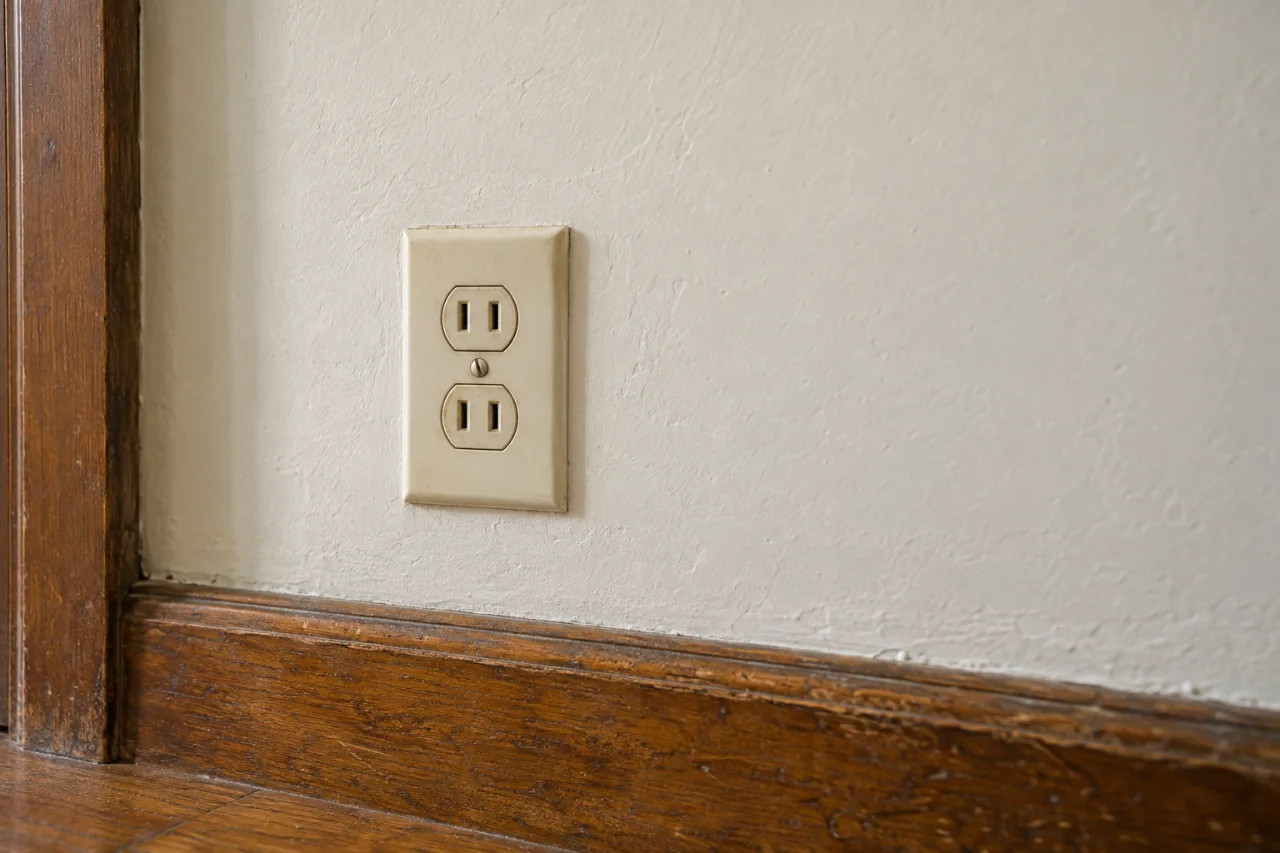
A receptacle accepting a three-prong plug is not, by appearance alone, evidence of a verified grounding path. Leviton's guidance explains that certain ungrounded installations can receive GFCI receptacles without adding grounding. The GFCI and the grounding path serve different purposes; one should not be described as the other. (leviton.com)
Ask whether grounding has been verified, whether shock protection is appropriate and whether the connected equipment needs a grounded supply. GFCIs detect leakage-current imbalance and interrupt power to reduce shock risk, but adding protection does not repair damaged wiring elsewhere. Discuss applicable replacement rules and labeling with the electrician rather than choosing a device solely because its face looks newer. (esfi.org)
6. Compare electrical demand with the existing circuits
Frequent trips and everyday dependence on extension cords deserve attention even without a visibly damaged outlet. ESFI notes that power strips add connection points, not circuit capacity. Its guidance also recommends having insufficient outlet provision evaluated rather than relying on extension cords as a permanent arrangement. (esfi.org)
List the equipment normally used together: countertop appliances, portable heating, workshop tools or home-office equipment. Add planned purchases to the conversation. Ask whether the concern involves load on one branch circuit, a wiring fault or service capacity; do not assume a larger panel is the answer to every trip. Our guides to why a circuit breaker keeps tripping and planning an electrical panel upgrade can help organize those questions. (cpsc.gov)
7. Gather records without opening equipment
Prepare observations, not experiments. Do not deliberately reproduce overheating or a trip, remove panel covers or open outlet boxes. CPSC explicitly reserves service-panel cover removal for qualified electricians. Your records can help focus the discussion without exposing you to hidden electrical parts. (cpsc.gov)
For a Moore County property, ask which permitting authority serves the address and what the proposed work requires. Moore County publishes an individual trade-permit application covering electrical work; that does not mean every repair has identical permit requirements. Clarify responsibility for any required application and inspection before approving the project. (moorecountync.gov)
- Gather previous electrical invoices, inspection reports and available permit records.
- Record the room, symptom, frequency and equipment operating when the issue occurred.
- Describe whether one outlet, several rooms or a larger area was affected.
- List recent renovations and planned appliances or other substantial electrical loads.
- Photograph visible exterior damage only from a safe location; do not open equipment.
- Ask what remains unexamined or uncertain after the assessment.
8. Choose a documented scope, then keep the records
Request a scope that separates immediate corrections, recommended improvements and optional future capacity. Ask what evidence supports each item, which alternatives were considered and what limitations would remain after a smaller repair. North Carolina's inspection guidance emphasizes professional evaluation to determine whether repair, modification or replacement is appropriate when older aluminum branch wiring is present. (ncosfm.gov)
For budgeting, ask whether the proposal includes access work, devices and wiring, required permits, inspections and wall restoration. Compare exclusions as carefully as the total. The companion guide to what affects the cost of wiring repairs offers another way to prepare questions.
After work, keep the scope and completion records, request appropriate maintenance and device-testing instructions, and report recurring symptoms rather than accepting them as resolved indefinitely. (esfi.org)
The Electric Knight provides Wiring Repairs for West End and Moore County homes and businesses. When discussing your concern, describe what you have observed and ask how the proposed work addresses the cause—not simply the age of the house.
Questions & answers
Does an older house automatically need complete rewiring?
No. Age is a reason to investigate the system's history and condition, not a complete diagnosis. Inspection findings, alterations, wiring type and present loads should guide the scope. A working light or outlet alone does not establish safety. (cpsc.gov)
Can aluminum branch wiring be repaired instead of replaced?
CPSC describes permanent connection-repair alternatives as well as replacement with copper. These are specialized approaches, not ordinary outlet replacements. Ask which method is proposed, whether the electrician has the necessary qualifications and how all affected connections will be addressed. (cpsc.gov)
Will a GFCI turn a two-slot outlet into a grounded outlet?
No. GFCI protection can reduce shock risk without creating an equipment-grounding path. A qualified electrician can determine whether a GFCI replacement is appropriate, what labeling is required and whether the equipment being used needs a grounded circuit. (leviton.com)
Should I keep resetting a breaker that trips?
Do not treat repeated resets as a solution. Frequent trips are a warning sign requiring qualified evaluation. Record what was operating and which areas lost power without deliberately recreating the problem. Never increase breaker size simply to stop tripping. (nfpa.org)
Can electrical work be divided into phases?
Ask whether the findings support a safe phased plan. North Carolina's home-inspection guidance distinguishes aluminum-wiring concerns with and without immediate hazardous symptoms, but absence of symptoms is not proof of safety. Any staged proposal should identify urgent work, remaining concerns and limitations. (ncosfm.gov)
Sources & further reading
- U.S. Consumer Product Safety Commission: Guide to Home Wiring Hazards
Inspection history, warning signs, added loads, safe homeowner boundaries and qualified assessment of home wiring.
- U.S. Consumer Product Safety Commission: Repairing Aluminum Wiring
Older aluminum branch-wiring hazards and the distinctions between copper replacement, COPALUM repair and AlumiConn remediation.
- Electrical Safety Foundation International: Understanding Your Home Electrical System
Wiring-system types, older aluminum branch circuits versus other aluminum applications, knob-and-tube concerns and grounding.
- National Fire Protection Association: Electrical Home Fire Safety
Electrical warning signs requiring qualified attention and the temporary role of extension cords.
- Electrical Safety Foundation International: Don't Overload Your Home
Overload symptoms, insufficient outlet provision and why power strips do not increase circuit capacity.
- Leviton Product Support: What Is a Non-Grounding Outlet?
The distinction between ungrounded receptacles and GFCI replacement without an equipment-grounding connection.
- Electrical Safety Foundation International: Ground Fault Circuit Interrupters
How GFCIs detect leakage-current imbalance and reduce electrical-shock risk.
- North Carolina Office of State Fire Marshal: HILB Statutes and Rules
North Carolina home-inspection guidance on older aluminum branch wiring, hazardous symptoms and evaluation of repair or replacement needs.
- www.mass.gov
Guidance referenced in this article on Older-Home Electrical Problems: Targeted Repair or a Broader Upgrade.
- www.cdc.gov
Guidance referenced in this article on Older-Home Electrical Problems: Targeted Repair or a Broader Upgrade.
- https://www.nfpa.org/education-and-research/home-fire-safety/electrical-safety-in-the-home?dm_i=42N5%2CS1DU%2C51B1MR%2C3F866%2C1%2C0%2C0%2C0
Guidance referenced in this article on Older-Home Electrical Problems: Targeted Repair or a Broader Upgrade.
- https://www.moorecountync.gov/258/Building-Applications
Guidance referenced in this article on Older-Home Electrical Problems: Targeted Repair or a Broader Upgrade.
- https://www.esfi.org/home-electrical-safety-challenge/
Guidance referenced in this article on Older-Home Electrical Problems: Targeted Repair or a Broader Upgrade.
Prepared and automatically checked on . Conditions, costs and requirements can change. Ask about the details that apply to your situation.
Continue reading
Helpful next reads

Is This an Electrical Emergency? Warning Signs and Safe Next Steps
A practical guide to choosing between evacuation and 911, a utility hazard report, and an electrical repair request—without approaching damage or testing suspect equipment.
Why Does a Circuit Breaker Keep Tripping?
A repeatedly tripping breaker may be protecting you from an overload or electrical fault—not asking to be replaced. Learn which patterns matter and when to leave the circuit off.
Planning an Electrical Panel Upgrade: Loads, Permits and Inspections
Before agreeing to a panel replacement or service upgrade, understand what is driving the recommendation, what the proposal includes and how permits, inspection and power restoration will be coordinated.