
Practical guides · local
Planning Outdoor Lighting in Moore County: Weather, Glare and Landscape
Useful outdoor lighting starts with the route to the door—not the brightest fixture. Plan for glare, moisture exposure, controls, growing plants and the requirements that apply to your Moore County property.
What you’ll learn
- Define the walking and entrance tasks before selecting fixtures or deciding how much light to add.
- Confirm the property's planning jurisdiction; one municipality's standards do not govern all of Moore County.
- Address shielding, aiming and neighboring sightlines before increasing brightness.
- Match fixture suitability to actual moisture exposure and mounting conditions.
- Plan controls, vegetation clearance and future maintenance together.
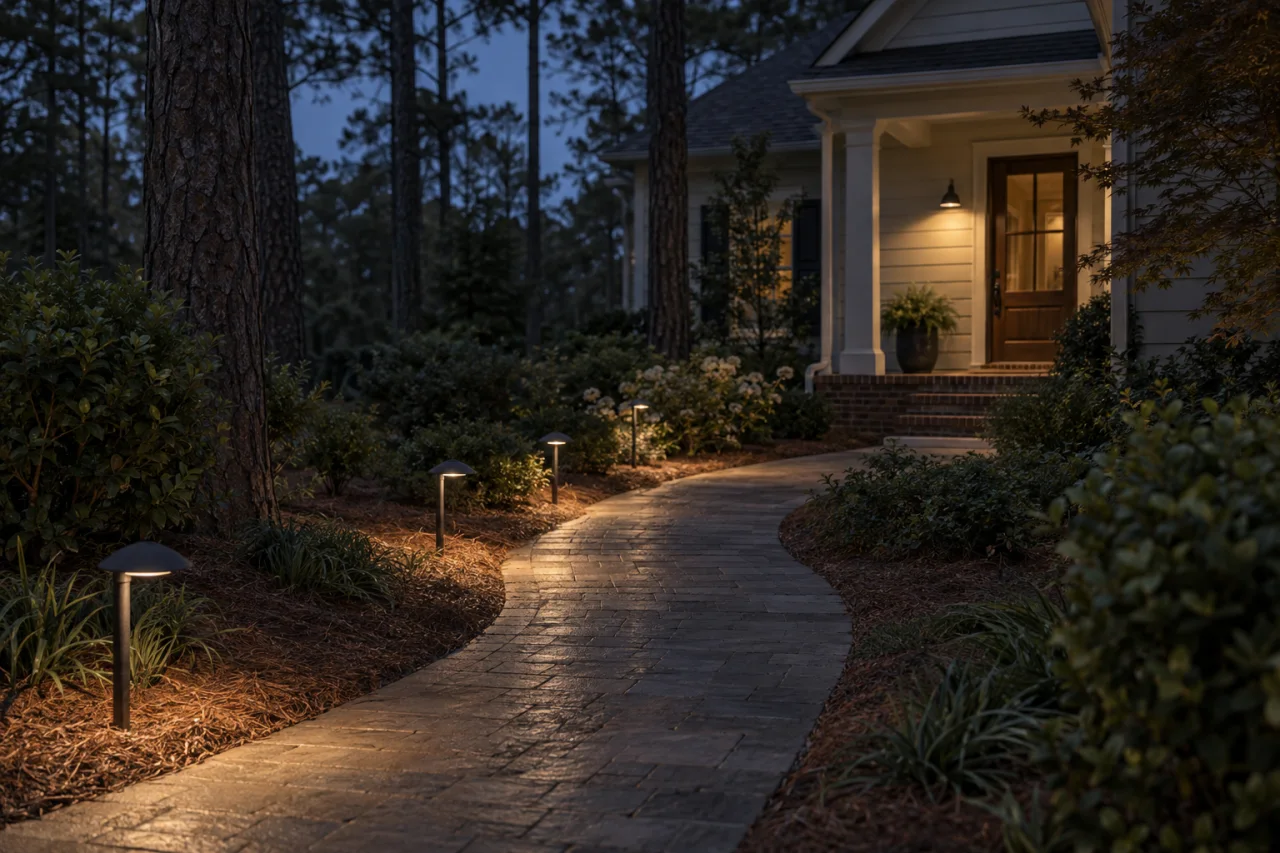
A comfortable entrance does not require an illuminated yard from boundary to boundary. It requires light in the places people need to see, without a bright source competing for their attention. For a Moore County home or business, a practical Outdoor Lighting brief should connect paths and doorways with rain exposure, neighboring windows, operating hours and changing vegetation. Start with those conditions, then choose fixtures and controls—and check the requirements for the property's actual jurisdiction before committing to a layout.
Start with the route people actually use
Begin with the trip from the driveway or parking space to the door. Which turn, step, change of surface or entrance needs to be visible? Note where someone stops to find keys, carry groceries or greet a visitor. Give each proposed light a specific task before choosing its style.
Separate essential wayfinding from optional landscape accents. A light that reveals a step serves a different purpose from one that highlights a tree. Keeping those purposes separate makes it easier to decide what should remain on, what can dim and what can switch off after an evening outdoors.
For a useful brief, describe the problem in ordinary terms: the last step disappears into shadow, the porch lamp shines into approaching eyes, or visitors miss the turn toward the door. Those observations are more useful than a request to make the whole yard brighter.
Check the property's jurisdiction before choosing fixtures
A Moore County location does not mean one set of lighting rules applies everywhere. The county's Unified Development Ordinance generally governs unincorporated land outside municipal planning and development jurisdictions, with stated exceptions. Municipalities have their own development requirements; Pinehurst, for example, maintains a separate development ordinance with a lighting chapter.
Before buying equipment, identify the authority responsible for the property. Then describe whether the project involves a home, business, parking area, sign or another use. Applicability and exceptions matter: a standard written for a particular development type should not be treated as a universal residential rule.
Private restrictions are a separate consideration, not a substitute for public requirements. Ask about both early enough that fixture selection and placement can respond to them.
- Confirm the parcel's planning jurisdiction rather than relying only on its mailing address.
- Ask which zoning, overlay or historic-review requirements apply to the proposed work.
- Ask whether lighting plans, permits or inspections are required for this particular scope.
- Check applicable association standards or recorded restrictions separately.
Control glare before adding brightness
Judge lighting from the places people will experience it: approaching the entrance, walking back toward the driveway and looking toward nearby windows. A fixture can illuminate the ground while still exposing an uncomfortable bright source at eye level.
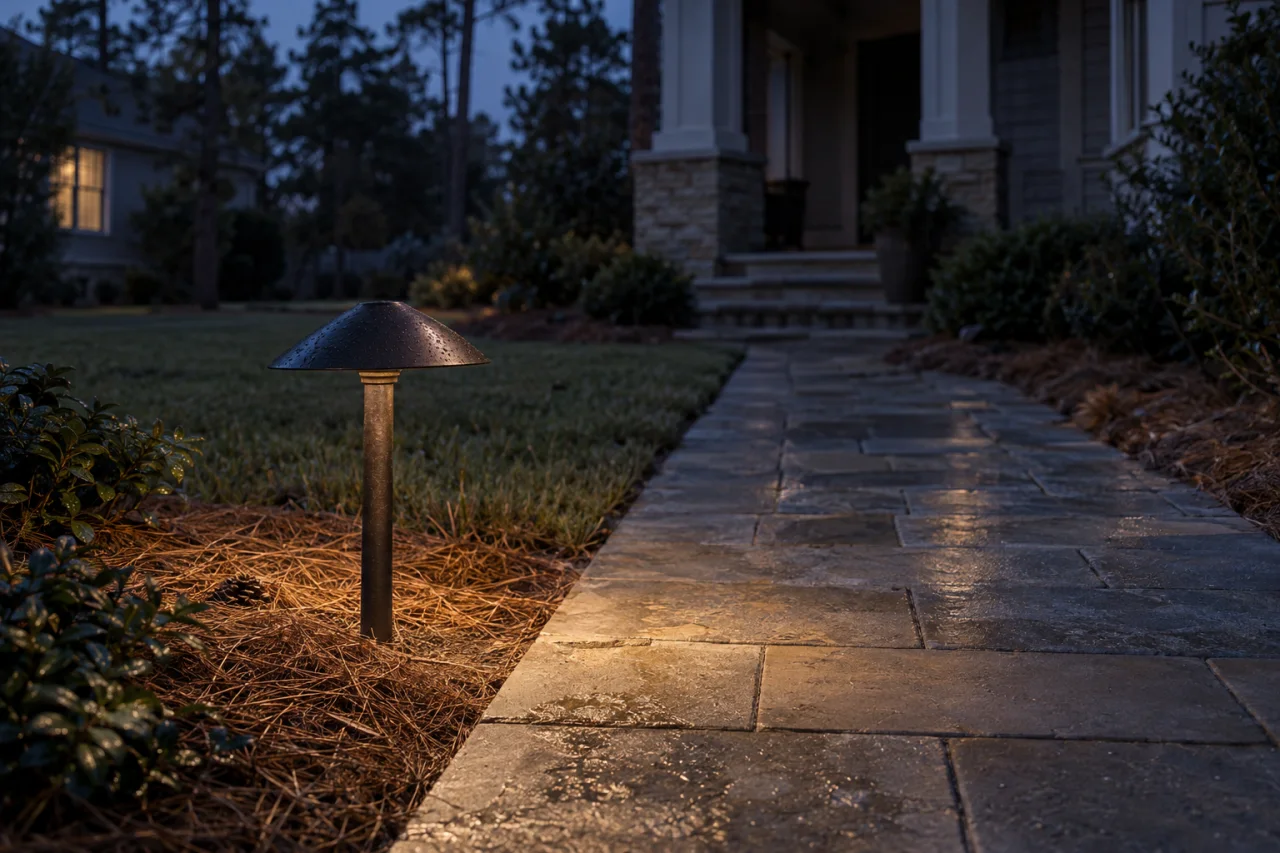
Shielding limits where light escapes; aiming determines where the useful beam lands. A decorative clear-glass lantern and a shielded downlight may have similar output but distribute it very differently. Prefer equipment that directs light onto the intended surface rather than relying on a brighter lamp to overcome poor placement.
Use the lowest output that supports the task, and consider warm-colored light. Warm color alone does not prevent glare: shielding and direction still matter. Nor should additional brightness be treated as a guarantee of security. The planning goal is useful visibility without unnecessary spill onto neighboring property.
Match the fixture to rain, splash and mounting conditions
Rain exposure is a product-selection issue, not just a finish preference. A covered position can still experience moisture or wind-driven splash. Identify whether condensation, dripping water, irrigation or direct rainfall can reach each proposed location.
Damp-location fixtures are intended for moisture conditions that include partially protected locations. Where water can drip, splash or flow against equipment, wet-location suitability matters. Also check mounting restrictions: a wet-location marking does not by itself establish suitability for every ground-level or recessed installation.
Ask to review the proposed fixture's suitability and installation instructions before approving it. Do not assume that the word outdoor, an attractive metal housing or a weather-themed product name answers the exposure question.
Exposure questions for fixture selection; final suitability depends on the actual location, product markings and installation instructions.
| Condition | What to discuss | Important limitation |
|---|---|---|
| Partially protected location with condensation | A fixture suitable for damp or wet locations | A roof overhead does not rule out dripping or splash exposure. |
| Exposed path or entrance with water reaching the fixture | A fixture suitable for wet locations | Check permitted mounting position and installation details as well. |
| Recessed fixture at or below ground level | A product specifically suitable for ground-mounted recessed use | An ordinary wet-location fixture is not automatically suitable for this installation. |
Choose controls around arrivals and evening use
Think of controls as part of the lighting design rather than an accessory added afterward. A timer suits a predictable evening routine. A motion sensor can provide light for occasional arrivals, but its coverage and shutoff delay need to suit the approach. A daylight sensor prevents daytime operation; by itself, it does not determine whether light is needed throughout the night.
Different areas may deserve different schedules. The route to an entrance may need light later than a patio or ornamental planting. Ask whether those groups can be controlled separately instead of keeping every fixture on for the longest required period.
When considering LED Lighting, confirm compatibility with the proposed dimmers and controls. Also ask how settings are changed and whether ordinary operation remains straightforward. For equipment tradeoffs, the LED options guide explains replaceable bulbs, retrofit kits and integrated fixtures.
Allow for growth, not just today's planting
Treat the landscape as something that will change. For each proposed position, ask what happens when a nearby shrub fills out, seasonal planting is added or a branch extends across the intended beam. Leave those questions in the brief rather than assuming regular pruning will always preserve the original arrangement.
During a nighttime walk, note foliage that intercepts light, obscures a fixture or leaves the intended surface in shadow. After landscape changes, reassess the result before deciding that a more powerful lamp is needed. Ask whether repositioning or a different distribution would better address the obstruction.
Include access in the decision: can the fixture be reached for appropriate cleaning and service without disturbing established planting? A plan that depends on difficult access deserves scrutiny before installation.

Make nighttime observation part of ongoing care
Plan to observe the lighting after dark, when beam direction and neighboring sightlines are apparent. Assess the walking route in both directions. Look for light reaching beyond its purpose, sources visible directly to the eyes and controls that activate at the wrong time.
Repeat that observation when seasonal use or landscaping changes. Follow product instructions for homeowner maintenance, and leave electrical alterations or work beyond your familiarity to an electrician. A brief record of which light causes difficulty and under what conditions can make a service discussion more productive.
For a more detailed observation list, see outdoor lighting maintenance. Maintenance planning should preserve useful light, not gradually increase output to compensate for unresolved placement or obstruction problems.
Bring a focused brief to the project discussion
A useful proposal should connect equipment choices to the conditions you have identified. Ask which existing components can remain, what new parts or access are needed, and how fixture suitability, controls and placement will be addressed. Clarify whether related landscape or surface restoration is included rather than assuming it is part of electrical work.
The Electric Knight offers Outdoor Lighting for homes and businesses in West End and Moore County. To prepare for a discussion, gather your observations and priorities, arrange an appropriate assessment and review the proposed work before proceeding. A clear brief helps keep the decision focused on usable paths, comfortable entrances and a landscape that does not need to be illuminated everywhere.
- Identify the routes, steps and entrance tasks that matter most.
- Record neighboring windows and other sensitive sightlines.
- Describe water exposure and likely plant growth at each location.
- Choose operating periods for essential and decorative lighting separately.
- Ask what the proposal includes, excludes and assumes about existing equipment.
Questions & answers
Do Pinehurst lighting rules apply everywhere in Moore County?
No. County and municipal planning jurisdictions differ. Confirm which authority governs the parcel, then ask which requirements apply to its use, zoning district and proposed work. A mailing address alone is not a reliable basis for choosing an ordinance.
Is a damp-rated fixture suitable under any covered porch?
Not automatically. A partially protected location may be damp, but water that drips, splashes or flows against equipment creates a wet-location concern. Actual exposure, the fixture marking and its installation instructions should guide selection.
Should path lights stay on from dusk until dawn?
Only where the need justifies that operating period. A timer can serve predictable evening use; motion activation can suit occasional arrivals. A photocell responds to daylight, not whether someone needs the light, so consider combining it with scheduling.
Will a brighter LED solve an uncomfortable entrance light?
Not necessarily. If the source shines into your eyes or beyond the property, more output can worsen the problem. Review shielding, aiming and mounting position before increasing brightness.
What should I bring to an outdoor-lighting discussion?
Bring photographs of the routes and entrances, your usual arrival times, observations about glare and water exposure, and any applicable association requirements. Explain what you need to see rather than starting with a fixture count.
Sources & further reading
- Moore County Unified Development Ordinance, amended April 21, 2026
Section 1.5 provides readable jurisdiction provisions distinguishing county planning jurisdiction from municipal jurisdictions and addresses private agreements, covenants and deed restrictions. Supports checking the parcel's governing authority and private restrictions separately. ([moorecountync.gov](https://www.moorecountync.gov/DocumentCenter/View/496/Chapters-1---20-Unified-Development-Ordinance-08-19-2025-PDF))
- Pinehurst Development Ordinance, adopted November 18, 2025, amended December 23, 2025
Verifies that Pinehurst maintains its own development ordinance and a distinct lighting chapter with applicability provisions. Used to support jurisdiction-specific review, not to impose Pinehurst standards throughout Moore County. ([vopnc.org](https://www.vopnc.org/home/showpublisheddocument/15592/639029501938930000))
- DarkSky International: Five Principles for Responsible Outdoor Lighting
Supports purpose-driven lighting, shielding, downward aiming, minimum necessary output, attention to reflective surfaces, controls and warmer light. These principles inform the route, glare and takeaway guidance. ([darksky.org](https://darksky.org/RESOURCES/guides-and-how-tos/lighting-principles/))
- UL Luminaires Marking and Application Guide, July 2016
Environmental location markings explain damp and wet conditions, required suitability markings, ground-mounted recessed restrictions and installation instructions. Supports the exposure section, comparison table and damp-location FAQ. ([code-authorities.ul.com](https://code-authorities.ul.com/wp-content/uploads/2014/09/Luminaires_MG.pdf))
- DarkSky International: Responsible Home Outdoor Lighting
Supports reviewing residential light spill, shielding, unnecessary brightness, operating periods and warm-colored lighting. Provides the basis for observing individual fixtures and neighboring-property effects. ([darksky.org](https://darksky.org/what-we-do/advancing-responsible-outdoor-lighting/home/))
- International Dark-Sky Association: Home Lighting Assessment, January 2020
Supports assessing each light's purpose, mounting height, aiming, output and controls; testing for inappropriate sensor activation; and using an electrician for unfamiliar electrical work. ([darksky.org](https://darksky.org/app/uploads/2020/01/Home-Lighting-Assessment-Print.pdf))
- University of Illinois System EnergySense: Outdoor Lighting
Supports prioritizing wayfinding objectives, considering the complete fixture assembly and placement, selecting among scheduling and sensor strategies, and checking lamp compatibility with planned controls. ([energysense.uillinois.edu](https://energysense.uillinois.edu/outdoor-lighting/?utm_source=openai))
- U.S. Department of Energy: Chapter 7, Landscape Design and Management
Supports avoiding excessive contrast and the assumption that brighter lighting is inherently better for security, limiting all-night operation to justified needs, and using focused fixtures to reduce spillover. ([energy.gov](https://www.energy.gov/sites/prod/files/2013/12/f5/sustainable_guide_ch7.pdf?utm_source=openai))
Prepared and automatically checked on . Conditions, costs and requirements can change. Ask about the details that apply to your situation.
Continue reading
Helpful next reads
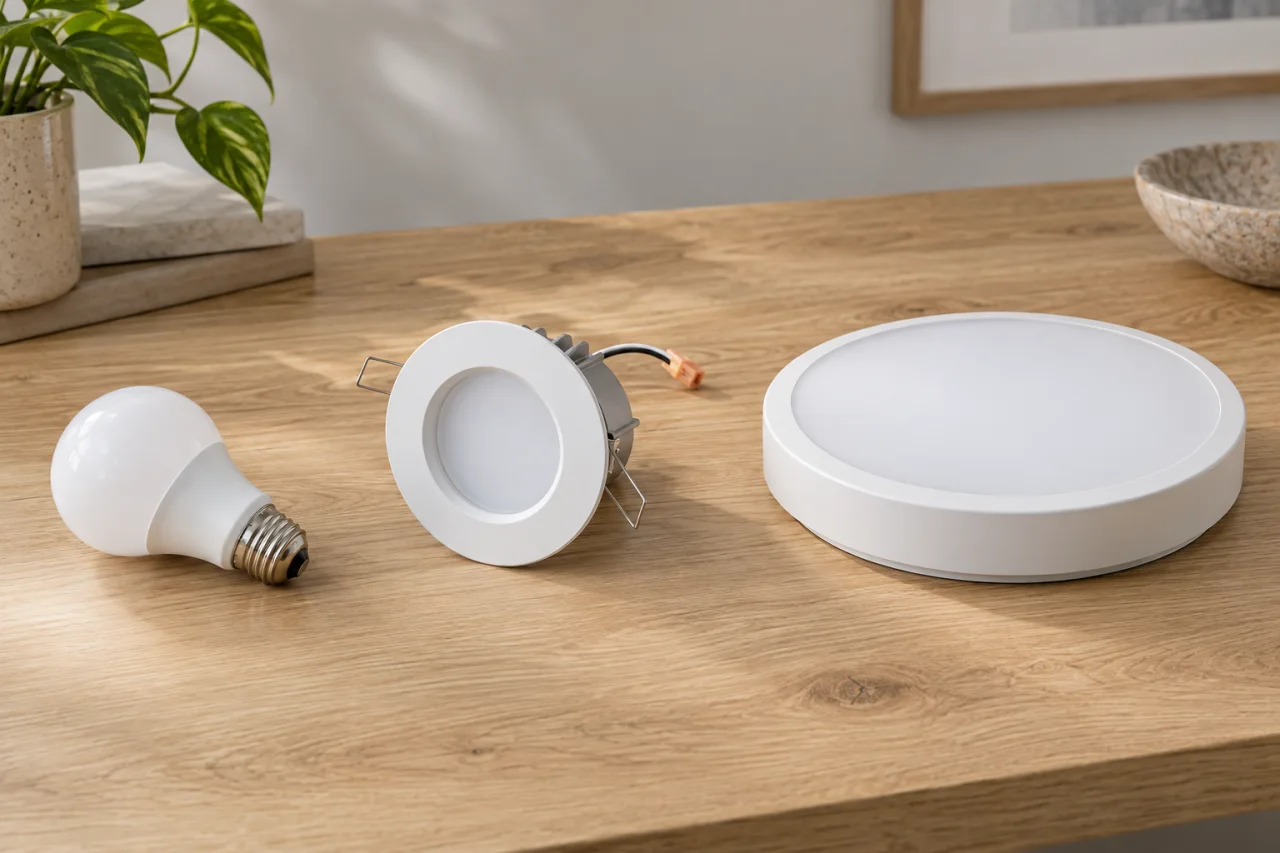
LED Options Guide: Replaceable Bulbs, Retrofit Kits or Integrated Fixtures?
The best LED choice depends on what you want to keep, how the light performs and what happens when a component fails. Compare the practical tradeoffs before buying.
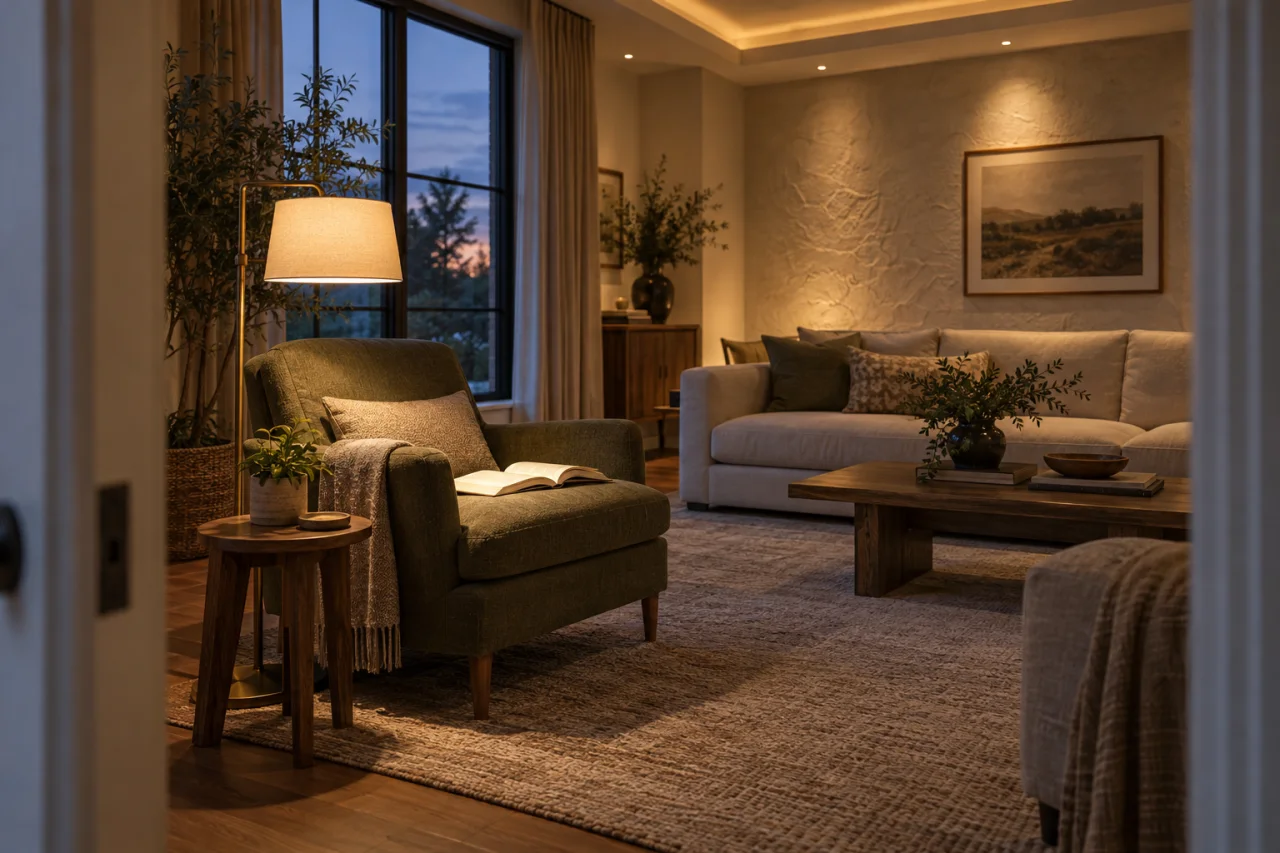
How to Plan Room Lighting Before Choosing Fixtures
A comfortable room needs more than brighter bulbs. Map activities, daylight and furniture, then plan light placement, controls and maintenance before choosing fixtures.
Why Do LED Lights Flicker, Buzz or Refuse to Dim Properly?
LED flicker and buzzing can reflect a bulb–dimmer mismatch, but symptoms alone cannot rule out an electrical fault. Learn what to record, what compatibility means and when to stop troubleshooting.