
Practical guides · maintenance
Outdoor Lighting Maintenance: What to Observe and When to Call
Learn what to observe, how to approach manufacturer-directed cleaning and timer changes, and which outdoor lighting problems need professional repair or emergency help.

What you’ll learn
- Routine care starts with safe observation and the instructions for the exact fixture and control.
- Exterior debris and blocked beams differ from internal moisture, damaged wiring and broken fittings.
- Repeated protective-device trips need assessment, not repeated resets.
- Smoke, flame, active arcing, electrical burning odor or suspected shock calls for moving to safety and calling 911.
Outdoor lighting maintenance is less about taking fixtures apart and more about noticing what has changed. A blocked beam, dirty exterior lens or unwanted operating schedule may call for routine attention. A cracked housing, water inside a fixture or repeated electrical trip calls for a different response. For homeowners in West End and across Moore County, this guide separates safe observation and manufacturer-directed care from work that belongs with an electrician.
1. Begin with a safe visual review
Start by looking, not touching. From a dry, stable walking route in daylight, note broken lenses, leaning posts, missing fittings, damaged outlet covers and cable that has become visible. Do not move a damaged fixture to see underneath it.
If there are no apparent hazards, observe the lighting again after dusk. Which walking surfaces remain dark? Has a spotlight begun shining toward a window instead of its intended feature? Record locations rather than trying adjustments in the dark.
Keep hands-on care separate from observation. Before cleaning, follow the manufacturer’s instructions for disconnecting or isolating power and allow the fixture to cool. A timer being in its off period is not a substitute for safe isolation. If you cannot confidently identify the correct power source, leave cleaning to a professional. Keep routine care at ground level; do not improvise ladder access to elevated fixtures.
2. Clean according to the fixture, not a universal recipe
Cleaning advice is not interchangeable between finishes, lenses and fixture types. Find the instructions for your particular model before choosing a cleaner. A product suitable for one glass lens may be unsuitable for another fixture’s coating.
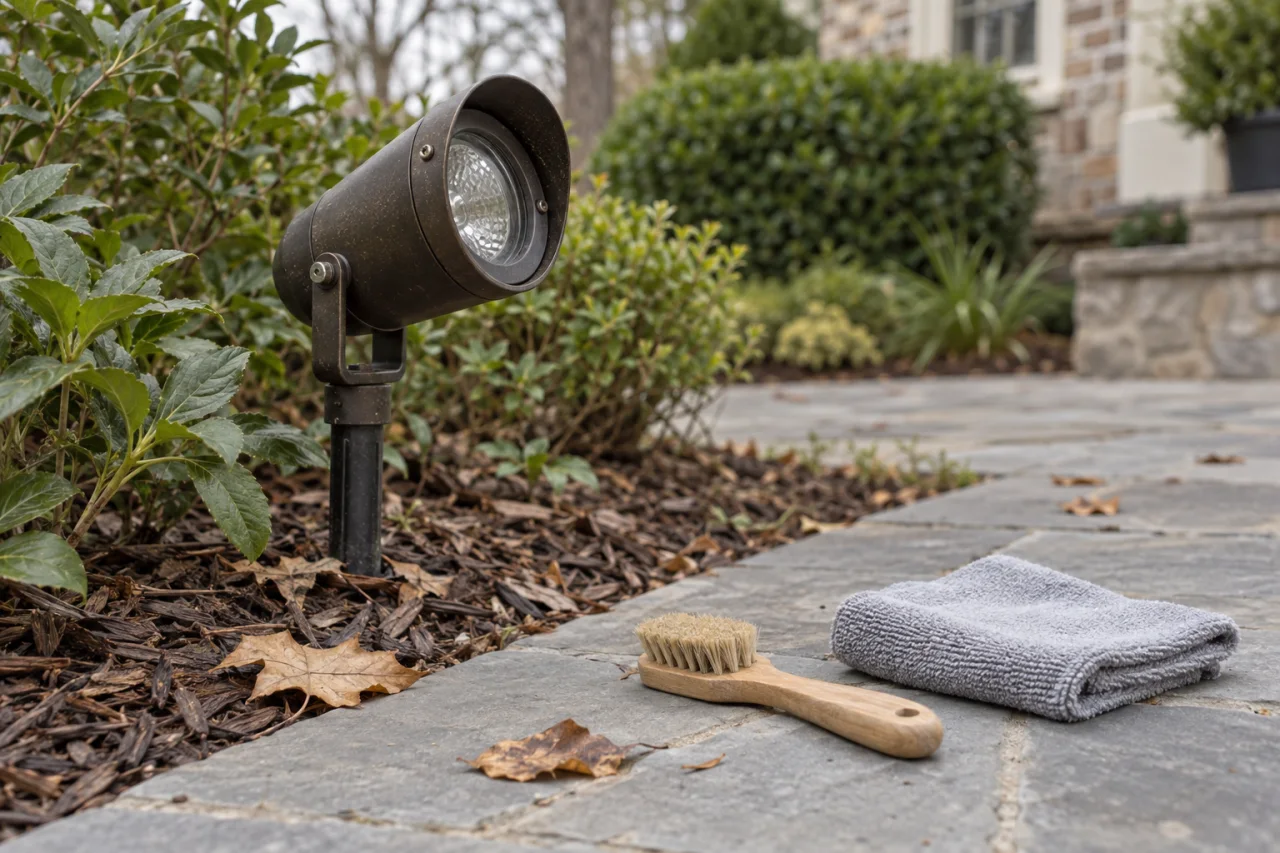
For intact, accessible equipment that has been safely isolated, a soft brush can remove loose exterior debris. Follow the approved method for any remaining dirt. Some landscape fixtures permit gentle soap and water; that does not mean every housing can be soaked or sprayed. Avoid abrasive pads and unapproved household cleaners.
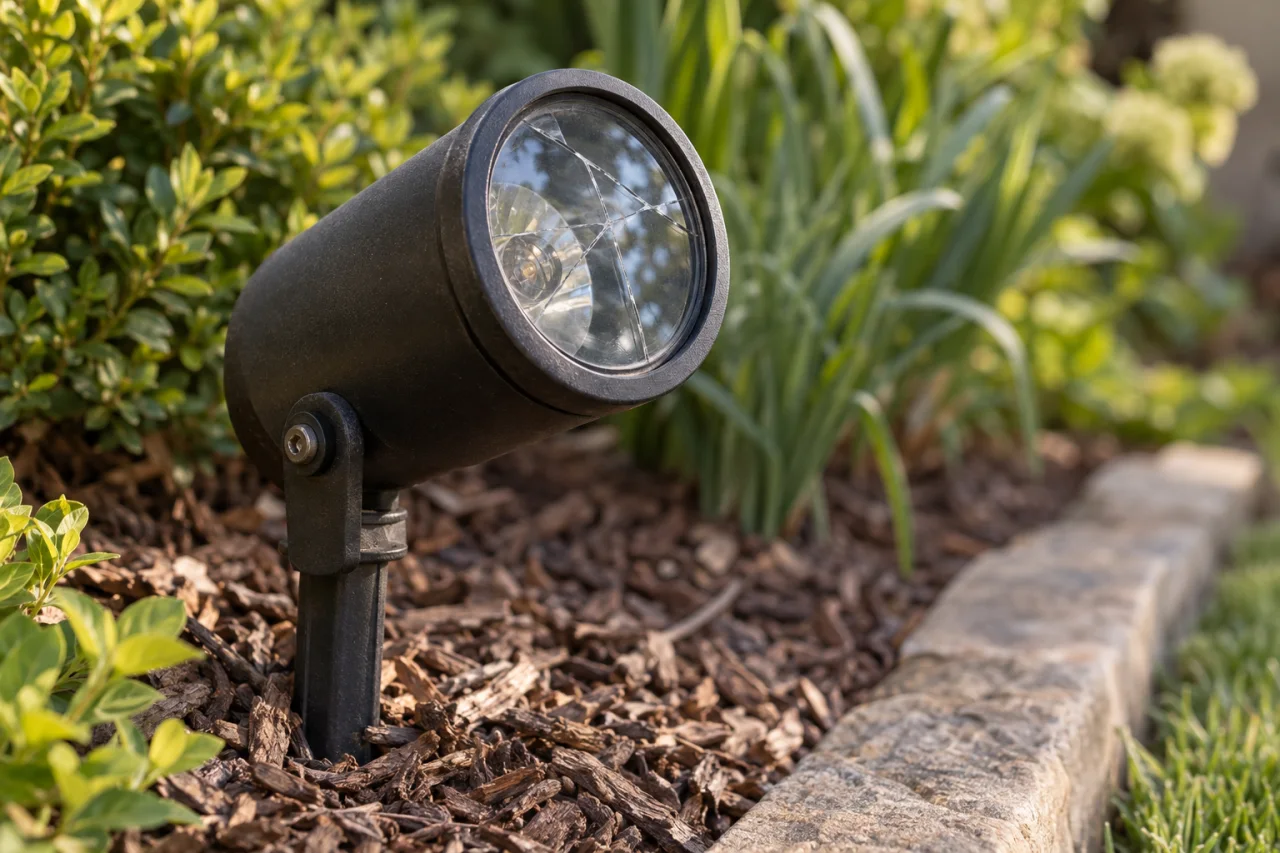
Limit this task to accessible exterior surfaces. Do not remove sealed lenses, loosen fittings or open a transformer enclosure to clean inside. Dirt outside and moisture inside are different problems. If you notice a crack, loose component or internal water while cleaning, stop rather than trying to restore the fixture’s appearance.
3. Keep the landscape from overtaking the light
Growing plants can obscure a beam even when the light itself works correctly. Fallen leaves can collect over recessed well lights, while mulch or pine straw may accumulate around fixtures. Note these changes during garden upkeep.
After safe isolation, clear loose exterior debris only where this can be done without disturbing equipment or cable. Follow any manufacturer-specified clearance rather than assuming one distance suits every fixture. Plan pruning carefully so tools cannot strike a light or its wiring; vegetation near utility lines belongs with the utility or an appropriate professional.
If a path light leans after mowing or landscape work, do not pull it upright by its shade. Record the damage and ask whether its support or cable needs attention. For broader changes to beam placement and glare, planning outdoor lighting in Moore County can help you reconsider the layout rather than simply adding brighter lights.
4. Review schedules before assuming equipment has failed
Lights operating at an unexpected hour may need a schedule review, not a new fixture. Use only the normal homeowner controls described in the manual. Compare the programmed operating period with when you actually need the path, entrance or patio illuminated.
Where applicable, check the displayed time, day, time zone and daylight-saving setting. Some smart controls can follow local dusk and seasonal daylight changes automatically; do not assume your system has that feature or that it is enabled.
Make one documented change at a time and observe the next cycle. Do not open electrical compartments to reach controls or bypass a sensor to test a theory. If correct settings do not restore normal operation, describe the symptom when arranging an assessment.
5. Use this checklist to separate care from repair
The useful boundary is whether the task stays outside intact equipment and within the manufacturer’s homeowner instructions. Clearing approved exterior debris or changing an accessible schedule is different from diagnosing a fault.
Repeated trips, broken fittings, damaged insulation and water entering a housing need professional attention. Do not tape over damaged cable, apply household sealant to a cracked fixture or substitute an extension cord as a permanent supply.
A repeated trip without fire or shock signs calls for leaving the affected system off and arranging assessment—not automatically a 911 call. The guide to why a circuit breaker keeps tripping explains why the protective device should not be treated as the nuisance.
- Observe from a dry, stable location before considering any hands-on care.
- Match cleaning methods and vegetation clearances to the equipment instructions.
- Keep cracked lenses, broken fittings and visibly damaged cable out of use pending assessment.
- Do not repeatedly reset a breaker or GFCI to keep lighting operating.
- Do not open electrical connections, transformer compartments or sealed fixtures.
- For smoke, flame, active arcing, electrical burning odor or suspected shock, move to safety and call 911.
6. Treat water and buried-cable trouble as separate concerns
Visible internal water, recurring trouble after rain or a light affected by recent digging deserves a closer professional assessment. These observations are clues, not proof of a particular failed part.
Do not remove a lens to drain water, pull cable from the soil or dig along a suspected wiring route. Leave buried-wiring diagnosis and Wiring Repairs to an electrician. Before any planned excavation, use 811 and ask separately how privately owned lighting cables will be identified; do not assume every garden cable is covered by a utility locate.
If equipment has been flooded or submerged, do not re-energize it simply because the outside looks dry. Keep away from standing water around electrical equipment. Where a safe, dry approach to the normal disconnect is unavailable, do not attempt isolation yourself.
7. Recognize when to step away and call 911
Smoke, flame, active arcing or an electrical burning odor changes the priority from maintenance to emergency response. Move away, keep others clear and call 911 from safety. Do not delay the call to investigate a housing, find the exact fault or contact an electrician first.
For suspected electric shock, call 911 or have someone else call. Do not touch a person who may still be in contact with electricity, and follow the dispatcher’s instructions.
Never enter water to reach electrical controls. Only isolate power if doing so is safely accessible without approaching the hazard or delaying escape. Electrical repair follows emergency response; it does not replace fire-service or medical help.
8. Make the repair conversation specific
For a non-emergency assessment, prepare a short description: which lights are affected, whether the problem is constant or intermittent, and whether it followed rain, mowing, excavation or a schedule change. Photographs taken from a safe position can help explain location and visible damage. Do not recreate the fault for a video.
Ask whether the proposed work addresses an individual fixture, its support, controls, power supply or wiring. Request clarity about parts, access, excavation and landscape restoration where relevant. A targeted repair and a replacement fixture may have different compatibility and access requirements; appearance alone is not enough to choose between them.
The Electric Knight provides Outdoor Lighting for West End and Moore County homes and businesses. Discuss what you have observed, arrange an appropriate assessment and review the proposed work before proceeding.
Questions & answers
How often should I look over outdoor lighting?
Use the equipment’s maintenance instructions as your baseline. A seasonal visual review is a practical reminder, with additional observation after storms or nearby landscape work. Check from a safe distance rather than handling anything displaced or damaged.
Can I use household glass cleaner on fixture lenses?
Not automatically. Some cleaners can damage coatings or finishes. Use only the cleaning method approved for the particular fixture, with power safely isolated before cleaning. Do not remove sealed lenses to reach dirt or moisture inside.
Does low-voltage landscape lighting make damaged wiring safe to handle?
No. Do not handle damaged cable or exposed conductors. The system also has a power supply connected to household electricity. Leave electrical diagnosis and repair to a qualified professional.
Should I reset a breaker whenever the outdoor lights go out?
Repeated resetting is not maintenance. If a breaker or GFCI trips repeatedly, leave the affected lighting off and arrange electrical assessment. Smoke, flame, active arcing, an electrical burning odor or suspected electric shock requires moving to safety and calling 911.
What if water appears inside a fixture?
Treat visible internal moisture as a reason for assessment rather than opening the housing or drying it with heat. Keep the affected equipment out of use. Never enter standing water to reach a switch, plug or electrical panel.
Sources & further reading
- Kichler Lighting — Landscape Maintenance
Landscape-maintenance guidance on exterior lens debris, foliage blocking beams, displaced path lights, deteriorated gaskets, damaged wire and maintenance records. Its professional electrical-maintenance instructions are not presented as homeowner tasks. ([kichler.com](https://www.kichler.com/tips-guides/landscape-lighting-guide/landscape-maintenance))
- Kichler Lighting — Installation and Care FAQs
Turning off electrical current before cleaning, gentle soap and water for applicable landscape fixtures, drying surfaces, and avoiding abrasive or potentially coating-damaging cleaners. ([kichler.com](https://www.kichler.com/customer-care/faqs/installation))
- Kichler Lighting — Mobile App Support
The limited, model-dependent statement that compatible smart lighting controls offer custom schedules, location-based astronomical scheduling and daylight-saving adjustments. ([kichler.com](https://www.kichler.com/customer-care/AppSupport))
- Electrical Safety Foundation International — Outdoor Electrical Safety Check
Following outdoor-equipment instructions, observing damaged wiring, qualified repair, seeking an electrician for unexplained trips, keeping equipment away from water and avoiding ladders near overhead lines. Historical code descriptions and statistics are not used. ([esfi.org](https://www.esfi.org/wp-content/uploads/2021/08/Outdoor-Electrical-Safety-Check-Booklet-English-AA13.pdf))
- Electrical Safety Foundation International — Electrical Safety: Think Outside the Home
Calling 811 before digging, avoiding power lines, weather protection for outdoor outlets and the limitation that extension cords are temporary rather than permanent wiring solutions. ([esfi.org](https://www.esfi.org/wp-content/uploads/2021/06/Electrical-Safety-Think-Outside-the-Home.pdf))
- CDC — What to Do to Protect Yourself From Electrical Hazards
Avoiding standing water when accessing electrical controls, obtaining qualified assessment before restoring wet equipment, calling emergency medical help for suspected shock and not touching someone still contacting an electrical source. ([cdc.gov](https://www.cdc.gov/natural-disasters/response/what-to-do-protect-yourself-from-electrical-hazards.html))
- Livermore-Pleasanton Fire Department — Report a Hazard
Calling 911 for an emergency in progress, an imminent threat to life or property, or suspected fire indicated by smoke or a strange burning smell; supports distinguishing emergency escalation from non-emergency repair. ([lpfire.org](https://lpfire.org/emergency-preparedness/report-a-hazard/))
- U.S. Fire Administration — Prevent Home Electrical Fires
Reserving electrical work for qualified electricians and replacing damaged electrical cords instead of attempting makeshift repairs. ([usfa.fema.gov](https://www.usfa.fema.gov/downloads/pdf/publications/prevent_home_electrical_fires_flyer.pdf))
Prepared and automatically checked on . Conditions, costs and requirements can change. Ask about the details that apply to your situation.
Continue reading