
Practical guides · decision
LED Options Guide: Replaceable Bulbs, Retrofit Kits or Integrated Fixtures?
The best LED choice depends on what you want to keep, how the light performs and what happens when a component fails. Compare the practical tradeoffs before buying.
What you’ll learn
- Start by deciding whether to retain the existing fixture, retain only its housing or replace the complete assembly.
- Compare brightness, color quality, glare and control compatibility separately; no LED format settles all four.
- A listed retrofit kit must suit the host fixture and be installed according to its instructions.
- Ask about replacement drivers, light sources and parts access before buying an integrated fixture.
- Rated life and warranty length are different; check labor coverage and exclusions.
There is no universal winner between replaceable LED bulbs, listed retrofit kits and integrated fixtures. The useful comparison is what each option lets you retain, how it lights the space and how it can be maintained later. A bulb change, a conversion and a complete fixture replacement are different decisions—not simply three price points. (energy.gov)
For homeowners and business owners considering LED Lighting in West End and Moore County, this guide offers a way to compare those decisions without confusing a long life rating with easy repair or warranty protection.
1. Choose what stays—and what changes
Start with the part you want to retain. Is it a decorative fixture, a recessed housing or simply the current lighting location? Then ask what you want to improve: brightness, appearance, control or future maintenance.
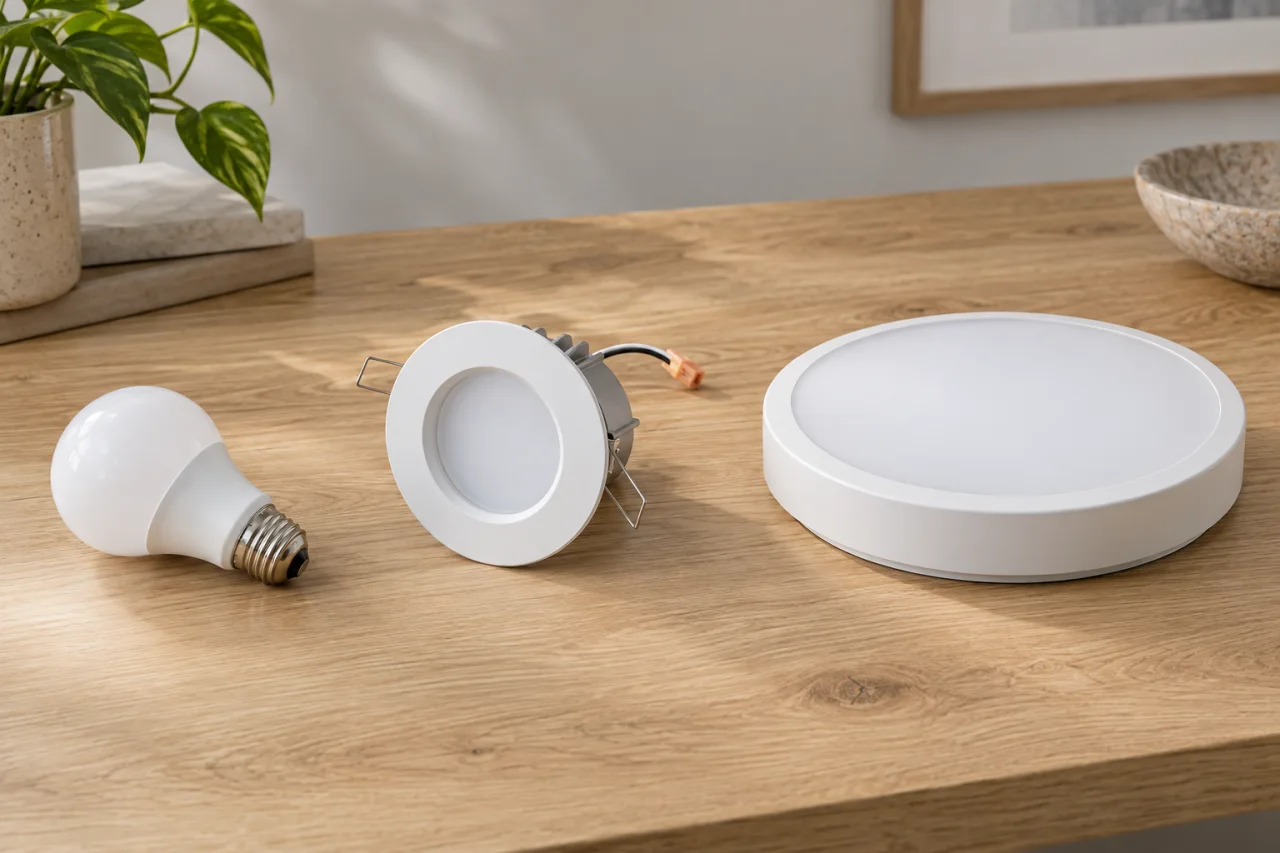
A replaceable LED lamp keeps the bulb-and-fixture arrangement. A retrofit kit converts a suitable existing fixture using a defined set of components. An integrated fixture incorporates the LED source into the fixture design; that does not automatically mean its components are replaceable—or permanently sealed. These distinctions make service instructions important. (energy.gov)
Use this comparison to narrow the options, then verify the exact product and installation requirements.
| Format | When to consider it | Main limitation |
|---|---|---|
| Replaceable LED bulb | Keeping a suitable fixture while changing its light source | The bulb can be replaced separately; fixture condition, light distribution and controls still matter |
| Listed retrofit kit | Retaining a suitable housing while converting its lighting components | The kit must match the host fixture requirements; retained parts and future replacement options need attention |
| Integrated LED fixture | Changing fixture form, optics or the complete lighting assembly | Serviceability varies; verify driver and light-source replacement rather than assuming either is possible |
2. Judge the light, not just the package
Compare lumens for light output and watts for electricity consumption. The FTC’s Lighting Facts guidance separates these measurements and explains the warm-to-cool appearance information on bulb packaging. Avoid choosing solely by a familiar incandescent-equivalent wattage. (consumer.ftc.gov)
Color temperature describes the light’s appearance; color rendering describes how objects look under it. DOE identifies CRI 90 or higher as excellent color fidelity, while noting that CRI has limitations, particularly with saturated reds. For kitchens, dressing areas or displays, compare samples on skin tones, food, fabrics and finishes rather than relying on one number. (energy.gov)
Brightness also needs direction. A bright exposed source or reflection in a screen can produce glare. Consider shielding, diffusion and viewing position—not just total output. Before buying a roomful of products, plan room lighting before choosing fixtures and evaluate a sample from the seats and work surfaces you actually use. (energy.gov)
3. Check enclosure suitability and retrofit certification
A bulb that fits the socket is not necessarily suitable for the fixture. Check the exact product instructions for enclosed use and moisture exposure. Feit Electric’s guidance, for example, distinguishes enclosure suitability from damp- and wet-location applications and includes additional enclosure restrictions. These details are product-specific. (help.feit.com)
A retrofit requires a different compatibility check. UL explains that a certified kit’s instructions identify acceptable host fixtures, either by model or by defined mechanical and electrical criteria. Physical fit alone is insufficient, and a certification mark on an individual component does not establish certification of the complete conversion. (ul.com)
Ask the installer to identify the applicable kit instructions and discuss whether the existing housing is suitable. Retaining a fixture should be a deliberate choice, not the default merely because a replacement module can be made to fit. UL’s retrofit guidance emphasizes the condition and compliance of the host fixture. (ul.com)

4. Match the controls before committing
“Dimmable” is a starting point, not a compatibility promise. Lutron recommends checking the exact dimmer model against its LED compatibility tool rather than relying only on general guidance. Record the proposed bulb or fixture model as well as the existing dimmer model before purchasing. (webtools.lutron.com)
Ask about the permitted load, number of connected lights and expected low-end performance. Feit Electric notes that the total LED load must fall within the dimmer’s minimum and maximum LED range. Do not use an incandescent load rating as your only selection criterion. (feit.com)
If control performance is already a problem, read why LED lights flicker, buzz or refuse to dim before replacing every fixture. Compatibility is one question worth resolving first; symptoms alone do not establish which component should be replaced. (help.feit.com)
5. Make repairability a purchasing requirement
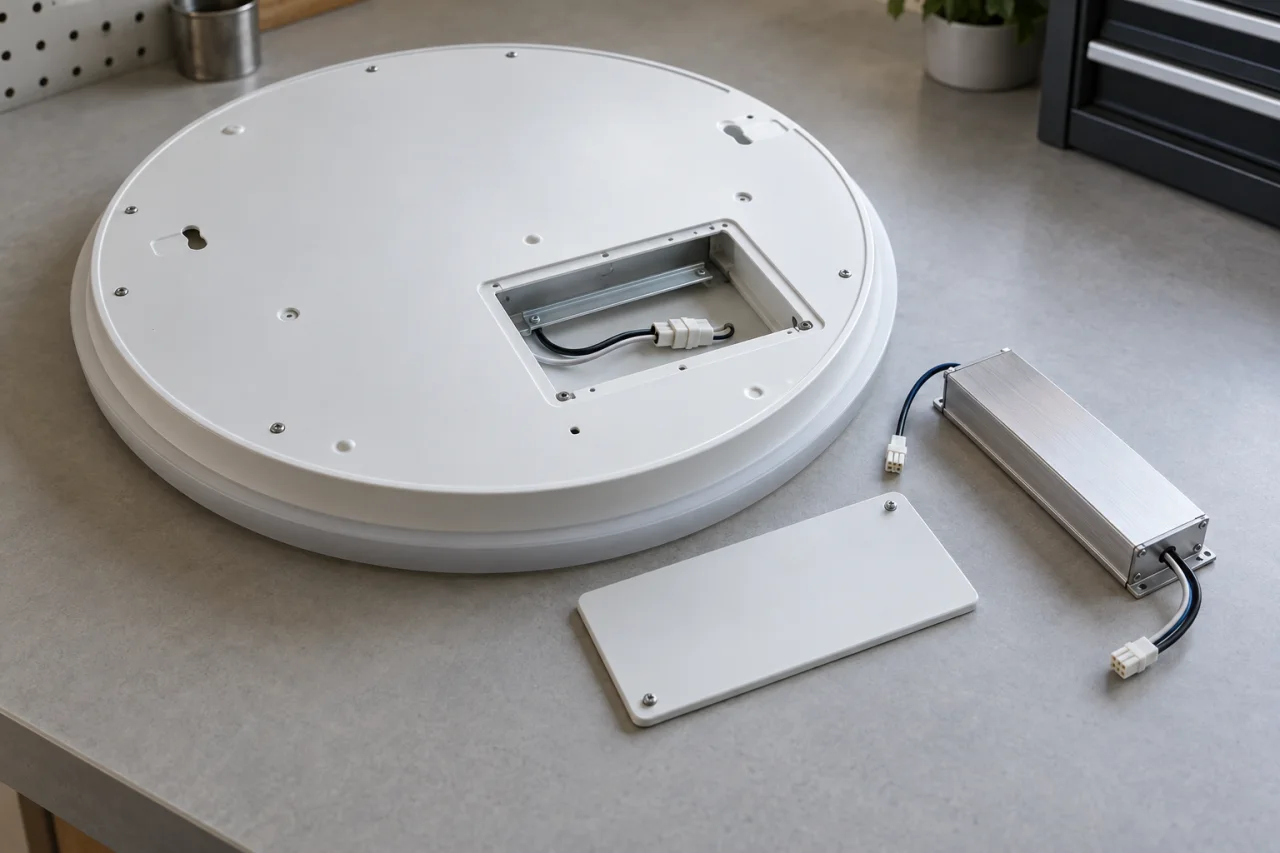
For an integrated fixture, ask two separate questions: can the driver be replaced, and can the LED light source be replaced? The driver regulates power to the source. A replaceable driver does not establish that the light source is replaceable too. DOE’s guidance treats drivers, sources and other components as parts of an overall system whose reliability matters. (energy.gov)
Request replacement part numbers, access instructions and the supplier’s current ordering route. Ask whether servicing requires removing the fixture or disturbing finished surfaces. These are purchasing questions, not assumptions that every integrated product can be repaired.
For a coordinated row of fixtures, also discuss what happens if a matching replacement is discontinued. A technically functioning substitute may not deliver the appearance you intended. Keep model information and purchase records so a future repair starts with the correct product details. (energy.gov)
6. Separate rated life from warranty protection
An LED life rating is not a promise that every component will operate for that period. DOE distinguishes gradual light loss, color change and complete failure; electronics can fail while the LEDs themselves remain capable of producing light. Ask what the published life claim measures and under which operating conditions. (energy.gov)
Then read the warranty for the exact product and market. As one concrete example, Signify’s May 2025 North American components warranty excludes removal and reinstallation costs, including labor. It also contains conditions concerning installation and use, plus exclusions involving power surges and other circumstances. Those terms illustrate why a headline warranty length is not enough; they do not describe every brand or product. (signify.com)
Ask who handles a claim, what proof is required, whether labor is covered separately and what replacement is offered if the original product is unavailable. Save the applicable warranty with the receipt.
7. Compare the complete scope and future upkeep
Compare proposals that deliver the same lighting outcome. Product price alone does not capture differences in color quality, optics, dimming or maintenance. DOE notes that these performance features affect LED pricing and that lifecycle economics depend on the application. (energy.gov)
For The Electric Knight’s LED Lighting and Lighting services in West End and Moore County, useful scope questions include access, existing equipment condition, required parts and whether controls are included. Ask for a clear distinction between retaining a fixture, converting it and replacing it.
For operating cost, compare actual input watts, expected hours of use and your electricity rate. Treat packaging estimates as comparisons with assumptions—not a forecast of your particular bill. The FTC recommends reviewing the Lighting Facts energy information alongside brightness. (consumer.ftc.gov)
Before approving an option, settle the following questions.
8. Keep a short decision and maintenance record
These questions turn a format preference into a practical specification. For retrofit conversions, certification and host-fixture suitability must be established through the kit documentation. For future upkeep, distinguish a serviceable design from a warranty remedy; they solve different problems. (ul.com)
After installation, retain product records and follow the manufacturer’s cleaning and maintenance instructions. Pay attention to reduced output or changing color as well as complete failure: LED lighting can become less useful before it goes dark. (energy.gov)
- Which exact product and certification apply to the proposed installation?
- Are brightness, color appearance, color rendering and glare acceptable in the room?
- Are enclosure conditions and the existing controls compatible?
- What is included: products, installation, control changes, access work and disposal?
- If a driver or light source fails, what can be replaced and where are parts obtained?
- What warranty exclusions apply, and who pays diagnostic, removal and reinstallation labor?
Questions & answers
Which LED format is easiest to repair?
A replaceable bulb offers a straightforward replacement path when the bulb itself fails. An integrated fixture may also be serviceable, but ask whether its driver and LED module are replaceable, how they are accessed and where matching parts can be purchased. Serviceability depends on the product, not simply its category. (energy.gov)
Can any LED bulb go inside an enclosed ceiling light?
No. Check the exact bulb’s enclosed-fixture rating and restrictions. Feit Electric, for example, requires enclosed-rated bulbs and adds restrictions concerning rubber-gasket fixtures. Do not assume that an outdoor or moisture rating also establishes enclosure suitability. (help.feit.com)
Does a dimmable LED work with any dimmer?
No. Match the exact lamp or fixture model to the dimmer manufacturer’s compatibility information. Lutron recommends an LED-rated dimmer and a model-specific search for best performance; a general dimmable claim is not a tested pairing. (webtools.lutron.com)
Does rated LED life tell me how long the warranty lasts?
No. Rated life describes expected performance under stated conditions; warranty terms define a separate remedy. Lumen maintenance does not establish the reliability of every electronic component, and a parts warranty may exclude removal and installation labor. Read both documents. (energy.gov)
Sources & further reading
- Federal Trade Commission: Shopping for Light Bulbs
Lumens versus watts, Lighting Facts information, color appearance and energy-cost comparisons.
- U.S. Department of Energy: LED Basics
LED optics, color rendering, CRI limitations, life-rating interpretation, electronic failure and performance-related price tradeoffs.
- UL Solutions: FAQ—UL Certified LED Retrofit Luminaire Conversion Kits
Host-fixture compatibility, conversion-kit certification, component-mark limitations and installation documentation.
- UL Solutions: Safety Standards for Luminaire Retrofit Kits
The importance of existing fixture condition and compliance before retrofit conversion.
- U.S. Department of Energy: LED Luminaire Lifetime—Recommendations for Testing and Reporting
System-level reliability, serviceability, maintenance, lumen depreciation and application-dependent lifecycle economics.
- U.S. Department of Energy: Lighting Specification Guidance for Schools
Driver function, light-source terminology, contextual glare and evaluating samples before larger purchases; used for general lighting concepts, not residential design requirements.
- Lutron: LED Compatibility Tool
Model-specific dimmer and LED compatibility checks.
- Feit Electric: LED Dimmer Compatibility
Minimum and maximum LED load considerations and tested dimmer pairings.
- https://help.feit.com/hc/en-us/articles/5180361419031-General-LED-FAQs
Guidance referenced in this article on LED Options Guide: Replaceable Bulbs, Retrofit Kits or Integrated Fixtures.
- https://www.signify.com/content/dam/signify/en-us/support/warranties/Signify_US_Warranty_Components_North_America-87-68.pdf
Guidance referenced in this article on LED Options Guide: Replaceable Bulbs, Retrofit Kits or Integrated Fixtures.
Prepared and automatically checked on . Conditions, costs and requirements can change. Ask about the details that apply to your situation.
Continue reading
Helpful next reads

How to Plan Room Lighting Before Choosing Fixtures
A comfortable room needs more than brighter bulbs. Map activities, daylight and furniture, then plan light placement, controls and maintenance before choosing fixtures.

Planning Outdoor Lighting in Moore County: Weather, Glare and Landscape
Useful outdoor lighting starts with the route to the door—not the brightest fixture. Plan for glare, moisture exposure, controls, growing plants and the requirements that apply to your Moore County property.

Why Do LED Lights Flicker, Buzz or Refuse to Dim Properly?
LED flicker and buzzing can reflect a bulb–dimmer mismatch, but symptoms alone cannot rule out an electrical fault. Learn what to record, what compatibility means and when to stop troubleshooting.